Kavvanah

Kavvanah, also spelled Kawwanah (Hebrew: “intention,” or “devotion”), plural Kavvanot, Kavvanoth, Kawwanot, or Kawwanoth, in Judaism, the attitude or frame of mind that is appropriate when one performs religious duties, especially prayer.

KAVVANAH (Heb. כַּוָּנָה; lit. “directed intention”), the phrase used in rabbinic literature to denote a state of mental concentration and devotion at prayer and during the performance of mitzvot. Although the demand for kavvanah as an obligatory component of religious prayer and action is not explicitly mentioned in the Pentateuch, it is clearly referred to by the prophets. Isaiah, for instance, condemns those who “with their mouth and with their lips do honor Me, but have removed their heart far from Me” (Isa. 29:13).

Kavvanah in Prayer

The Talmud attaches considerable importance to kavvanah in prayer. The Mishnah quotes R. Simeon’s dictum: “Do not regard your prayer as a fixed mechanical device, but as an appeal for mercy and grace before the All-Present” (Avot 2:13). It is, furthermore, related that the early ḥasidim used to wait an hour before and after prayer to achieve a state of kavvanah and emerge from it (Ber. 5:1). However, from the discussion in the Mishnah and the Gemara (Ber. 32b), it is clear that the rabbis, keenly aware of the “problem” of prayer were by no means unanimous in their interpretation of what proper kavvanah should be. Later medieval authors distinguished between the preparation for kavvanah which precedes prayer and the achievement ofkavvanah during prayer itself (e.g., Kuzari, 3:5 and 17), while repeatedly stressing the importance of both. Maimonides ruled as a matter of halakhah (which was not, however, agreed with by later codifiers) that “since prayer without kavvanah is no prayer at all, if one has prayed without kavvanah he has to pray again with kavvanah. Should one feel preoccupied or overburdened, or should one have just returned from a voyage, one must delay one’s prayer until one can once again pray with kavvanah… True kavvanah implies freedom from all strange thoughts, and complete awareness of the fact that one stands before the Divine Presence” (Yad, Tefillah, 4:15, 16). The Shulḥan Arukh states “better a little supplication with kavvanah, than a lot without it” (OH 1:4).

Many talmudic decisions relating to kavvanah were modified in the course of time. Thus, although the Mishnah (Ber. 2:5) states that a bridegroom is not required to read the *Shema on his wedding night (because he would not be able to achieve a proper degree of concentration), it was later ruled that “since nowadays we do not pray with proper attention in any case” he must do so (Sh. Ar., OH 60:3). Similarly, “even if one did not recite the Amidah with kavvanah, it is not necessary to repeat it,” since it is assumed that the kavvanah of the repetition would be no better (ibid., 101:1, and see Isserles, ad loc.).

In the Kabbalah kavvanot (the plural of kavvanah) denotes the special thoughts one should have at the recitation of key words in prayer. Very often these thoughts are divorced from the contextual meaning of the words and are of a mystical, esoteric nature. Some kabbalists were thus known as mekhavvenim (i.e., those who have kavvanot) and guides to kavvanot were written (cf. Emmanuel Ḥai Ricchi’s Mafte’aḥ ha-Kavvanot, Amsterdam, 1740).

Kavvanah in Mitzvot

This is defined as the intention of the person performing the action to do so with the explicit intention of fulfilling the religious injunction which commands the action. One example of a lack of kavvanah quoted in the Mishnah (Ber. 2:1) is the case of one who reads the Shema during the morning (or evening), for the purpose of study and not fulfillment of the mitzvah; another is the case of one who hears the shofar on Rosh Ha-Shanah accidentally and thus does not have kavvanah for the mitzvah (RH 3:7). All authorities agree that due kavvanah to perform such mitzvot is desirable. There is, however, a difference of opinion as to whether mitzvot performed without kavvanah are valid, or whether they must be repeated (cf. Ber. 13a; RH 28a; Sh. Ar., OH60:4).

The Meaning of The Ripple Effect Logo

TheRippleEffect_Logo_2inch_drk

The Ripple Effect logo was created by my talented friend, Jill Sauerburger. It is beautiful to me.

I thought it might be a good idea to take a moment and explain the significance behind it. It’s good to pause from time to time in order to review and remind ourselves of the meaning represented by those simple visuals we may encounter on a daily basis.

Symbols and icons representing rich truths are powerful and memorable. This logo was created with purpose, not necessarily just to look nice.

First off, let us simply say that the concept of “the ripple effect” reminds us that everything we do matters.Everything we say and do affects someone else. Actually, a lot of someone elses. It’s been reported that even the most introverted person will have a significant effect on ten thousand people in their lifetime. Everything we do affects the world in some way.

So this is represented by the most obvious part of the picture, the ripple right in the middle caused by the dipping leaf. What I like about the look of the branch, leaves, and ripples is that they are not neat, perfect, angular lines. It’s messy. Our journey and pursuit of God is not always perfect or goes as planned and predicted. This reminds me that the spiritual life is more about obedience than it is agenda. The word “THE” being on its side also lends to showing the reality of these unpredictable, not-always-how-we-think-it-will-look ways of God.

Notice how the ripples go out of the picture into the word “ripple.” What we do affects more than we think, see, anticipate, or know. What we do and say ripples outside of our normal, limited view. This should sober us, but also excite us to trust in what we do for the love of God, even if we don’t actually see the effects ourselves. They may just be outside our view.

The word “ripple” is all lower case. So many times we don’t feel our words or actions are significant. They seem so small, unheard, or unheeded. But the effect is greater than we know, thus the big bold word “EFFECT.” Do small things with great love and you will most certainly change the world for the better!

Finally, my favorite and most important part of the picture is that which you do not see. The branch isn’t hanging from mid air. In order for it to keep dipping in the water, it must be connected to a tree. This is Jesus, the true Vine, and us, the branches, from my favorite passage in all of Scripture–John 15:1-11. Not being able to see the tree reminds us that God is truly ineffable. And yet, we know He is there. He must be always there.

How beautiful a branch is when it is gently swayed by the wind. Jesus compared the Holy Spirit to the wind, the breath that moves us. Only a branch connected to the vine can be moved in this way. Disconnected, lying on the ground, not much happens other than withering.

May we stay connected to Jesus in order to affect the world supernaturally and forever, for good and for love–for God.

Hope you’ve enjoyed this, and that you will be reminded of these truths whenever you see The Ripple Effect logo!

Radical Help

God-Encounter-Picture-1

After decades of pastoring, counseling, and clumsy attempts at helping other people, I am coming to a not so obvious but compelling conclusion: Much of our helping is like hoping for first-class accommodations on the Titanic. It feels good at the moment but it is going nowhere. The big tear in the hull is not addressed, and we are surprised when people drown, complain, or resort to life boats. Most of the people I have tried to fix still need fixing. The situation changed, but the core was never touched.

But what is the core? And how do we touch it? What does it mean essentially to help another person? If we can find the answer to these questions, we are coming close to what the world religions mean by true ministry. It is absolutely unlike any other form of helping. It has many counterfeits and disguises. What Jesus, Buddha, Confucius, the saints, and the prophets are talking about is the Absolute Help, which alone is worthy of the name–the radical help that none of us can give to another. We can only point to it and promise that it is there. That is the first and final work of all true religion. All else is secondary.

Call it grace, enlightenment, peak experience, baptism in the spirit, revelation, consciousness, growth, or surrender, but until such a threshold is passed, people are never helped in any true, lasting sense. After the early stages of identity and belonging are worked through, real transformation does not seem to take place apart from some kind of contact with the Transcendent or Absolute. We now live in a secular culture that is largely afraid to talk about such contact except either in fundamentalist or vague New Age language. Neither is sufficient to name the depth or the personal demand of the true God encounter. What characterizes the trustworthy conversion experience is a profound sense of meeting Another, who names me personally and yet calls me to a task beyond myself. Therapeutic healing will always be an effect, but it is never the goal itself or even a concern. One’s own wholeness pales into insignificance in relationship to the wholeness one is now delighting in.

-Richard Rohr


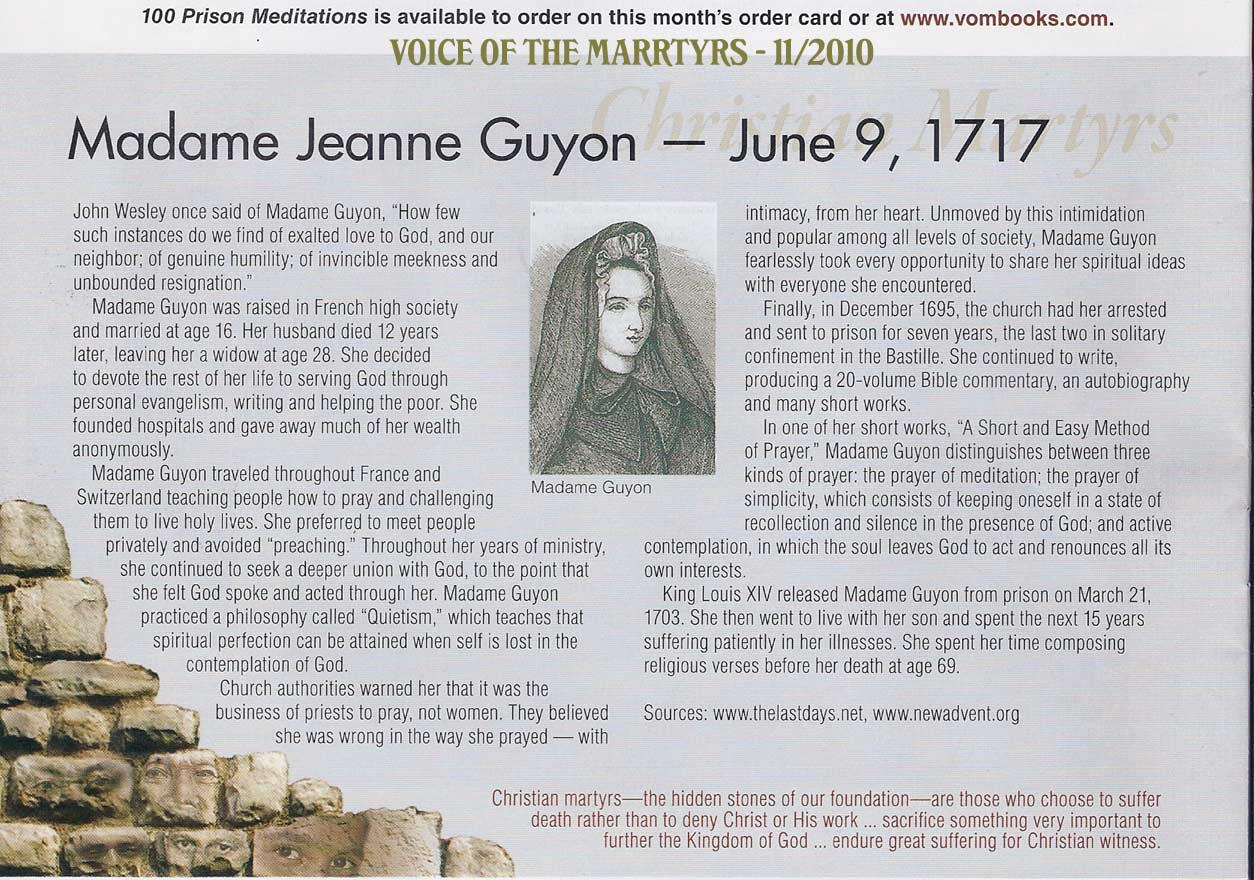
Meet Madame Jeanne Guyon

madame guyon

[click on picture to see full size]

Forget yourself. Think only of Him. In doing so, your heart will remain free and at peace.

It is essential to continually submit your will to God’s will and renounce every private inclination as soon as it arises–no matter how good it appears. You must want only what God has willed from all eternity. Forget the past. Devote the present to God. Be satisfied with the present moment which brings God’s eternal order to you. Attribute nothing that happens to you as coming from man, but regard everything, except sin, as coming from God.

-from Experiencing God Through Prayer p.28


If You Want to Get Warm You Must stand Near the Fire

If you want to get warm you must stand near the fire: if you want to be wet you must get into the water. If you want joy, power, peace, eternal life, you must get close to, or even into, the thing that has them. They are not a sort of prize which God could, if He chose, just hand out to anyone. They are a great fountain of energy and beauty spurting up at the very center of reality. If you are close to it, the spray will wet you: if you are not, you will remain dry. Once a man is united to God , how could he not live forever? Once a man is separated from God, what can he do but wither and die?

~ from Mere Christianity, by C.S. Lewis.

Spiritually Starving in the Midst of Plenty

pike

A wall-eyed pike is put into an aquarium. He is fed for some days with little minnows. Then, in the middle of the experiment, a glass partition is placed down the middle of the aquarium so that the pike is now confined to one side.

Then the researchers drop the minnows on the other side. Immediately, the pike goes for the minnows, but he hits himself against the glass. He circles and hits it again. He tries a third time, but he is now hitting the glass a little less hard. After a few more times, he’s just sort of nosing up against the glass. He has a feeling he’s not going to get those minnows. Pretty soon, he just swims around in circles and ignores the minnows on the other side.

At that point, those doing the experiment take out the glass. The minnows come right up against the gills of the pike and he doesn’t even try to eat them.

The experiment ends when the wall-eyes pike starves to death. He’s convinced he’s not going to get those minnows, so there’s no point in wasting his time or hurting his nose again. That is the best image of cultural blindness I have heard. I wanted to weep when I first heard it, but I realized that the experiment is about human beings, not about fish. That’s much of the human story, people spiritually starving in the midst of plenty. They don’t know how to eat.

-from Job and the Mystery of Suffering by Richard Rohr

This is an amazingly accurate metaphor for us, I believe. Starving in the midst of plenty.

The incredible, overwhelming, ginormous truth that is ever hiding right out in the open is this–we already have everything we need at this, and at every, moment.

We can always turn to God.

Only the eyes of faith are able to see this.

There is always a great feast sitting on the table.

Always.

Whether we see it, eat it, acknowledge it, or not.

I hear Jesus saying to us, “You can turn to me at any time.”

The Bread of Life, which leaves you hungry for nothing more, is always on the table ready to be taken and ingested.

God is always available to the diligent seeker, who approaches in utter humility, with a contrite heart, empty of self. We are free and able to connect with Christ at any moment of any day, if we but desire Him. I mean, truly desire HIM beyond all else.

The energy of God is ever flowing all around, in, and through us. We may tap into it whenever we so choose. We may stop whatever we are doing and thinking at any point, and turn our attention fully to Christ and rest in Him. When your attention is turned wholly to one thing, it is, by default, turned away from all others. Turning to the one thing needed, turns you away from all that matters not.

Is there any greater gift than this?

Is there anything simpler?

Is there anything more essential?

Is there anything more hidden?

“You can turn to me at any time.”

We need nothing else than to turn the gaze of our soul upon God in focused attention, and all will be made clear, for perspective shall miraculously become “unwarped” from its off-center state. Such intense focus on Christ, which blinds us to all else, is peace indeed–and worth fighting for.

Your healing presence absorbed, dear Jesus, is everything. May all other activity and thought take its rightful, very distant, second place to this!

There is plenty of food on the table. Minnows are constantly swimming right up to your gills. You may partake whenever you choose. What’s stopping you?

12.31.15–>”Looking Back on 2015. Looking Ahead to 2016″

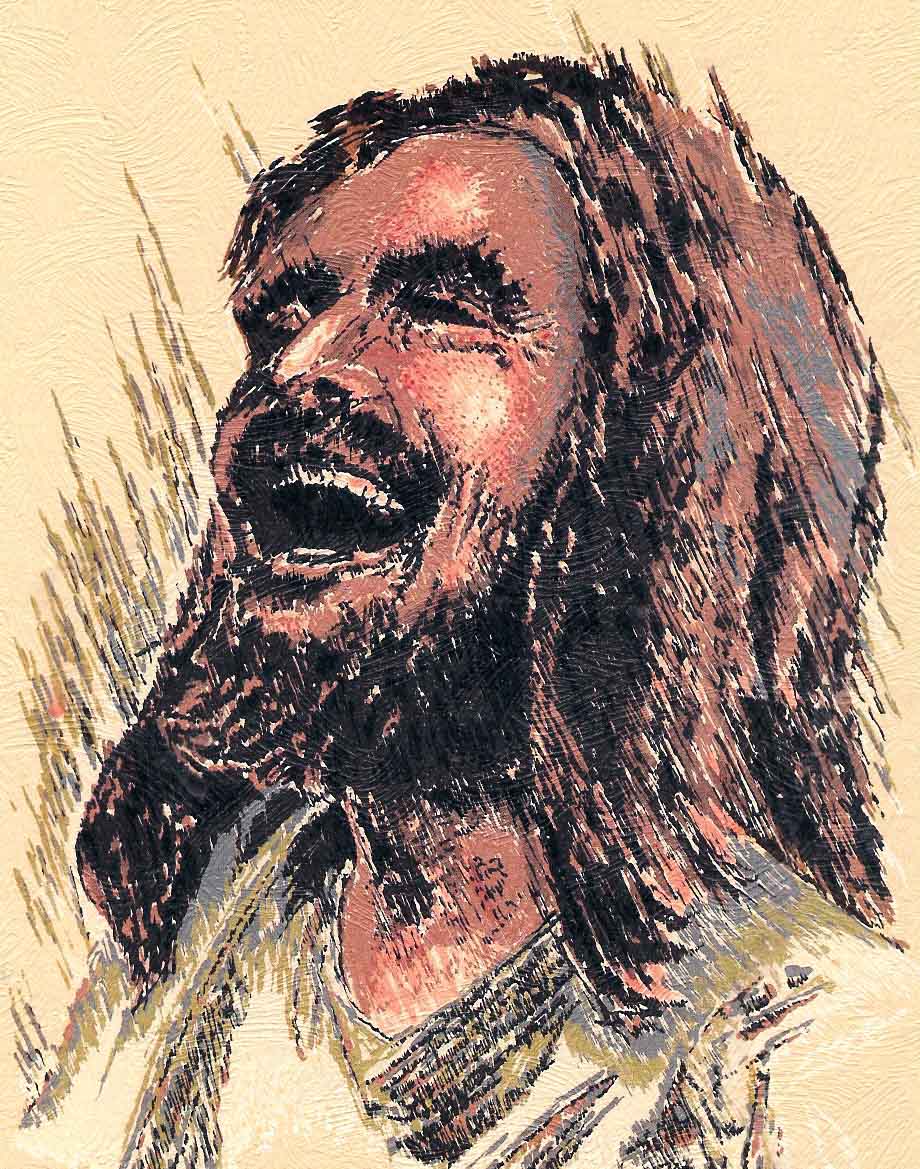
Jesus laughing

Psalm 46:10

Be still and know that I am God.

Reflection.

Reflection, I have found, to be a most important of practices for us. If we never stop to take inventory, we will probably not notice what is actually happening in our lives–what is  going well, what is not working, or even where God is in our day to day reality.

To paraphrase and extrapolate from the late great theologian, Chris Farley, If you never shut your big yapper, you’ll never hear anything! Am I right? It is in stopping that we notice; it is in silence that we hear.

So I hope this week, or even this day, you’re able to sit and reflect on 2015. You will doubtless see, first of all, that you have much to be thankful for.

Here are some prompts that a friend sent me last year this time which may help spark some 2015 reflection for you:

Consolations: What has been life gaining and deepened your sense of connection to God and God’s purposes for you? How could you strengthen these aspects of your life?

Desolations: What has been life draining and made you lose that sense of intimacy with God and your confidence in God’s purposes for you? How is God speaking to you through this?

What are the major pressures in your life? Where do you think the pressure comes from? What are the underlying causes? What is one thing you could do in the next year to relieve some of this pressure?

How do the above impact your spiritual well being? Write down the positive and negative impacts of the consolations, desolations, and pressures on your life. Share them with someone you wholly trust. Converse with God directly about how you can harness this impact so that your heart may be broken open to new possibilities for a better future. What is one new practice you could incorporate into your spiritual disciplines to maximize the life giving nature of these forces?

What is one thing you need to do every day?

I hope this is a help!


Looking ahead to 2016, after prayer and consideration, I feel led to send revised and updated versions of the “Daily Meds” of 2014 on the Gospel accounts and Proverbs.

First off, I love and feel the need for reading through the Gospel accounts daily. I do not believe we can ever exhaust the wisdom and Life contained in these four accounts. If you read nothing else, read these, for in them is Life indeed. In them is straightforward Jesus Christ.

Secondly, paraenesis. We need to be continually reminded of what we believe. I’d rather know a few things really well, than a thousand things only an inch deep. Reading a chapter a day, you will have read through all four gospel accounts every quarter, and the wisdom literature of Proverbs every month.

This is good.

There’s always something new to glean from these.

About a fourth of you signed up this year, so these will be completely new anyway. And for those of you who have seen them, I hadn’t sent pretty pictures with them before, so that’ll be exciting, won’t it!

Ok, well, I love you all, and I love connecting with you in this way. It’s almost like we spend a little time together everyday in some distant yet bonding manner.

I pray a blessing upon your day today and your new year starting tomorrow!

I pray that you will make spending focused, undistracted time with Jesus your first and most important priority of the day, every single day, starting right now. For it is reward beyond words that I shall never tire of promoting.