Category Archives: Daily Meditations

4.23.15–>”Practicing the Presence of God”

Brother Lawrence quote

Matthew 28:20

I am always with you, every single day, every single moment. [NRV]

No spiritual discipline is easier or more accessible to everyone than this one.

What is it?

It is simply waking up to God’s presence right now. All it requires is for you to remember that God is with you at this moment, for that is where God meets you–in the right now.

At this moment, as you read this sentence, remind yourself that you are submerged in God’s love.

BOOM. You just did it. You practiced the presence of God. That’s it. Could anything be easier? Now do that every moment of the day today.

There’s where the challenge arises. Not in the skill of doing it. If practicing God’s presence were in a game box, it would probably say “Skill Level 0” on it. It’s not difficult to do. There’s no math or even reading involved. The challenge is in the remembering it.

But the reward is infinite.

I believe that all spiritual disciplines end in this one, the conscious awareness and acknowledgement of the constant loving presence of God. Nothing is more transforming.

There’s been three authors* over the years known for having written on this practice (as well as having employed it mightily!), and they would all emphatically agree that remaining awake to God’s presence in the present moment is the single most important task of the Christian life and that no spiritual discipline is more foundational or transforming than this one.

Greg Boyd wrote a super fantastic little book on this in 2010 called Present Perfect. It’s one of those books I read every year at least once as it is such a beautiful reminder of what is most important. I love, and wholeheartedly agree with, what he shares personally on practicing God’s presence, so will leave us with his words today:

“I’ve been a Christian for thirty-four years now, during which time I’ve read close to a hundred books about the spiritual disciplines and attended numerous conferences on the subject. I’ve gained a lot of valuable insight from these sources. But like these three authors, I have found the simple practice of remaining  aware of God’s presence each moment brings me to the point toward which all other disciplines aspire. It is, I’m convinced, the bedrock of a vibrant relationship with God and the key to transformation into the likeness of Christ.”

Will you start today to remain awake to God’s presence and love for you each moment?


  • Brother Lawrence of the Resurrection (17th century)
  • Jean-Pierre de Caussade (17th century)
  • Frank Laubach (20th century)

In the Name of Jesus,
Soli Deo Gloria

4.22.15–>”Review & Reflection”

reflection

Review & Reflection

2 Corinthians 11:3

But the serpent tricked Eve with its cunning, and in the same way I’m afraid that your minds may be corrupted from the single-mindedness and purity which the Messiah’s people should have. [KNT]

In practicing what we preach, we will take a moment to review what we’ve gone over this month so far.We began on April Fools Day, as most Aprils begin, discussing “Small Wins.” Doing one small simple thing at a time consistently, watching it manifest into major breakthroughs. Small wins could also be called “Keystone Habits” as found in the incredible book The Power of Habit. What are those little things you can do everyday to bring you relationally closer to God and greatly improve your outlook on life?

The Point of it All. Before getting into some specific keystone habits for the spiritual life, it was important to know the point of it all so we knew the “why” of these habits. I believe we are here to become one with God just as Jesus said that He and the Father were one. To live a life of divine love and be filled with that divine love more and more everyday. In order to be filled, we must take advantage of the “means of grace” for the filling. “Operation: Fill & Spill” as I like to call it in order to become God’s Unconditional Love Machines spilling out His love onto the world. This is the healing of the nations–divine love through us all. Unless we employ those means of grace, I don’t see how we will be filled over time with more and more of God. That’s the point of these habits and the reason for the formation of them, to create space for the Spirit of Jesus to indwell us.

The means of grace, or maybe we could call them “filling stations” (this is what older people like my mom call gas stations), we are talking about this month are:

  • The Examen Prayer
  • Lectio Divina
  • Spiritual Partnership
  • Memorization
  • Practicing the Presence of God
Yesterday we finished the memorization part and the neurology to go along with it. Tomorrow we will start discussing The Practice of the Presence of God, which I believe to be key of keystone habits! This one was a real game-changer for me years ago and I look so forward to digging into it with you all…I wish we could do it in person. Hey, maybe we should have a monthly discussion time open to whoever wants to come. I just thought of that…I love the verse from 2 Corinthians above. May we never lose or stray from the simplicity of devotion to Christ.

Man, I am concerned you are losing your single-minded laser focus on Jesus and, therefore, your purity of devotion to Him which is what it’s all about! It’s like when that snake in the garden tricked Eve with his deceitful craftiness–the world and even religion bombards you with its lies, and it’s so easy to be led astray because of the constancy of it as well as the convincing eloquence with which it entices you.
2 Corinthians 11:3 [NRV]*


* New Roop Version: “Oh the NeRVe of this translation!”

In the Name of Jesus,
Soli Deo Gloria

4.21.15–>”The Neurology of the Good Samaritan”

What It All Leads

goodsamaritan-jesusmafa

Luke 10:25-37

“Which of these three, do you think, was a neighbor to the man who fell among the robbers?” He said, “The one who showed mercy.” Jesus said, “Go and do likewise.”

So why talk about memory, memorization, and the neuroscience of it?

Well, because of the Good Samaritan I guess. Isn’t the connection obvious?

Here’s the conclusion being drawn by some of the scientists:

It takes a calm, attentive mind to feel and also demonstrate empathy and compassion.

The neural processes for the higher emotions are inherently slow. They take some time to process, in all of us. And experiments with brain scans are showing that the more distracted we become, the less we are able to actually experience compassion, empathy, and other higher emotions.

Some Buddhist monks’ brains were actually studied in an MRI tube while they were meditating. And it was found that “compassion meditation” seemed to reset their brain so that it was always ready to respond to another’s suffering. Even while not meditating, their brains are trained to always give some response to suffering. The doctor studying them said, “It is like having a paramedic team on standby: It is ready to go at a moment’s notice, and so is the brain at which the capacity for compassion has been cultivated.”*

So it’s not just the feeling of the higher emotions, but the ability to act upon them. When Jesus was asked once about inheriting eternal life, He responded with the two most important things: Love God with your whole being, and love your neighbor as yourself. The lawyer who asked the question wanted some clarification on who his neighbor was. Jesus’ answer was the parable of the Good Samaritan–a guy who acted on empathy and compassion at a moment’s notice, no matter what else he had going on at the time.

I’m sure many of you have heard of the experiment done at a seminary, in which it was staged for someone to need attention on the pathway of students rushing to some theology exam. About a third of the students stopped to help the person. The others had to get to their God test!

The more distracted we become, the more focused on ourselves, the more we miss the point of it all.

Now we’re not saying the Internet is satan. It’s just that we do need to pay attention to what’s happening in us and in those around us. We don’t want to become “pancake people”, spread thin, always scattered, and unable to feel deeply for and attend to people; for then we lose our very humanity.

So memorize some Scripture for Christ’s sake (literally), and not just for memorization sake. But to ingest more of God and become an ever deeper human being.

Paradoxically, one of the things I love about all this science stuff is that, in the end, we see that we don’t really need all the science stuff. It’s fascinating to me and very fun, but all we really need is to take God at His word. As the old hymn goes, “Only Trust Him.” All of this stuff He has already told us for living the fullest life. To be single-minded, to meditate upon Him and His word, to care more for others than your own wants, to “think on these things”, etc. Perhaps as we get so modernized, God allows us to see more and more behind the curtain. The brain science that He knew waaaaaaay before we did.

“Trust me. I know what I’m talking about,” I hear Jesus saying. Brother Lawrence said it almost 400 years ago, “God is infinitely good and He knows what He is doing.” I wonder what an MRI would’ve shown of his brain….

Remember the picture of the still lake as the calm mind. You throw just a pebble in and you see it clearly. But the distracted mind is like the turbulent water. Throw in a boulder and you won’t even notice the effect. Becoming intimately one with YHWH changes us because it rewires how we see and what we are able to see. Flitting about from thing to thing or being overly concerned about our own well-being because we don’t entrust it to God (Mt.6:33) inhibits our vision for those around us in need.

But focusing on just a few things that matter and entrusting ourselves wholly to God enables us to be calm and at the ready to share in suffering and be Jesus’s healing touch to those around us.

Like a paramedic team on standby.

Is that how the world sees us?


*Richard J, Davidson, Ph.D.

In the Name of Jesus,
Soli Deo Gloria

4.20.15–>”What Determines What You remember & What You Forget?”

“That’s What Turns Me On About You. Your Attention To Detail.” -Ace Ventura

Mindfulness

Proverbs 4:1-2

Listen, children, to a father’s instruction, and be attentive that you may gain insight; for I give you good precepts: do not forsake my teaching.

OK, here’s the last section of brain science memory stuff. Hopefully it will tie it all together and reveal where it was all heading.

What determines what we remember and what we forget? The key to memory consolidation is attentiveness.

Storing explicit memories, and equally important, making connections between them requires strong mental concentration, amplified by repetition or intense intellectual or emotional engagement. The sharper the attention, the sharper the memory. Think of your sharpest memories. I know for me it’s the stuff I was most lasered into at the time, in the moment. Whenever I’ve studied something, at the exclusion of all else around me, that memory is burned into me a hundredfold opposed to those where I may have been drifting/unfocused/divided.

(As a kid I remember studying Star Wars magazines intensely over and over and over, as well as reading about how the movies were made whenever I could. To this day I have quite the plethora of Star Wars knowledge in my head that I could not get rid of If I wanted to. It’s actually ridiculous on some level how much I know and have retained about the Star Wars universe, but it does show me tangibly what this science is telling us these days.)

“For a memory to persist,” writes Eric Kandel, ” the incoming information must be thoroughly and deeply processed. This is accomplished by attending to the information and associating it meaningfully and systematically with knowledge already well established in memory.”

If we’re unable to attend to the info in our working memory, then it lasts only as long as the neurons that hold it maintain their electric charge–which is only a few seconds.

But attention…

Attention is a “genuine physical state” despite how ethereal it may sound.

Attention is a different ballgame. Paying focused attention sets off a chemical chain reaction in the brain solidifying it and jump starting the consolidation of explicit memory. Example: You don’t hear people much say, “No, I don’t really remember much about the time my first child was born.” Generally, you remember it intensely because you were paying so much attention to the moment, not thinking of what you needed to pick up at the store later. At least you moms were totally tuned in, I’m guessing!

The influx of competing messages we receive when we go online and what not overloads our working memory. It makes it tough for our frontal lobes to concentrate our attention on any one thing.  The process of memory consolidation can’t even get off the ground. And since our brains adapt so amazingly, we train our brains to be distracted–to process info very quickly and efficiently but without sustained attention. That explains why many of us feel it difficult to concentrate even when we’re away from our computer.

“Our brains become adept at forgetting, inept at remembering.”

God has granted us command over our attention.

“Learning how to think really means how to exercise some control over how and what you think,” said the novelist David Wallace Foster in a commencement address in 2005. “It means being conscious and aware enough to choose what you pay attention to and to choose how you construct meaning from experience.” We cede control over our attention at our own peril. Everything that neuroscientists have discovered about the cellular and molecular workings of the human brain underscores that point.

What is always playing in your mind? Or better maybe, what do you allow to always be playing in your mind? What is your life’s soundtrack?

May I suggest a nice soundtrack to start each day?

Let the morning bring me word of Your unfailing love.
God is good. His creation is good.
God only wants what is best for me.
Everything is either done or permitted by God in order to bring me to perfection.

I have found journaling to be an enriching experience of reflection and calm. I love the comparison of a calm mind to a very still lake. You throw in just a pebble and it is very noticeable, easy to pay attention to. But throw a rock into a turbulent lake, and you will hardly notice it, if at all. When we are single-mindedly focused, we are calm and able to see and notice what is really around and within us.

In the Name of Jesus,
Soli Deo Gloria

4.19.15–>”Filling a Bathtub With a Thimble”

Using a Thimble to Fill a Bathtub

bathtub

Luke 10:42

There is only one thing worth being concerned about.

It use to be assumed that long-term memory was simply a warehouse for storing facts, events, and impressions, and that it played little to no part in cognitive processing, thinking, or problem-solving. But brain scientists have now discovered that it is the “seat of understanding.”

It’s not just for storing facts, but complex concepts, or “schemas.” By organizing scattered bits of information and associating them all in ways we don’t even completely understand, schemas give depth and richness to our thinking. “Our intellectual prowess is derived largely from the schemas we have acquired over long periods of time,” says Australian psychologist John Sweller, who has, for three decades, studied how our minds process information and learn.

We saw yesterday that the depth of our intelligence hinges on our ability to  transfer information from our working memory to our long-term memory. It also depends on how we weave it into conceptual schemas. But this is quite the process. Remember, the working memory has a very limited capacity for processing info. It can hold just five to seven pieces, or “elements,” of information.  That, according to a 1956 paper. Now, it is believed that we can only process two to four elements at a time! And those elements we are actually able to hold on to quickly vanish “unless we are able to refresh them by rehearsal.”

Enter our picture of filling a bathtub with a thimble. That is the challenge involved in transferring info from your working memory to your long-term memory. It can only happen at a certain rate. This isn’t a bad thing, it just is. Different mediums bring info at you at varying velocities and intensities. For instance, on the more mellow end, you have reading a book. When you read a book, the information faucet provides a steady drip, which we can control by the pace of our reading. Through our single-minded concentration on the text, we can transfer all or most of the information, thimbleful by thimbleful, into long-term memory and forge the rich associations essential to the creation of schemas. With the Internet however, we face many information faucets, all going full blast. Our little thimbleful overflows as we rush from one faucet to the next  We’re able to transfer only a small portion of the information to long-term memory, and what we do transfer is a jumble of drops from different faucets, not a continuous, coherent stream from one source.

(Now I suppose we could read off the Net more slowly and with great concentration if we decided to, but it is not what this media promotes by its very “nature.”)

The info flowing into our working memory at any given moment is called our “cognitive load.” When the load exceeds our mind’s ability to store and process the information–when the water overflows the thimble–we’re unable to retain the info or to draw connections with the info already stored in our long-term memory.  We can’t translate the new stuff into schemas. Our ability to learn suffers, and our understanding remains shallow. Because our ability to maintain attention also depends on our working memory, we have to remember what it is we’re to be concentrating upon. A high cognitive load amplifies our distractedness we experience. When our brain is over-taxed, we find distractions more distracting. It gets harder and harder to distinguish relevant information from irrelevant. Tougher and tougher to simply pay attention to something.

Our brains are rewiring to adapt to our world and its current technology. We’re seeing more and more, but taking in less and less. We’re becoming what some refer to as “Pancake People,” covering a lot of area very thinly. This is from the cognitive overload which comes from many possible sources, but the two most important ones may very well be “extraneous problem-solving” and “divided attention.”

It’s interesting the theme though much of Scripture to be single-minded. “A double-minded man is unstable in all his ways.” I wonder if this is further application for us today. Perhaps it goes deeper and to more places than just the division of trying to serve two masters–God and money. God designed and created our brains, knowing how they function best. Knowing they are designed for single-mindedness to work optimally. He knew, before the Internet and iPhones, that divided attention hurts us in many ways.

Try focusing on just one thing at a time and see what it’s like. Use your little thimble with great contentment. Take five hours to fill that bathtub with the satisfaction of knowing it will be time very well spent, for it will embed goodness into that limitless process of renewal that is your long-term memory.

Energy flows, and stays, where attention goes.

In the Name of Jesus,
Soli Deo Gloria

4.18.15–>”Why Biological Memory is so much better than Computer Memory”

Implicit, Explicit, Working…

working memory

Man, I’m really on a memory kick this week. It’s fun, I’m gonna keep running with it.

So there’s different types of memory. Here’s some descriptions so that what follows will make more sense.

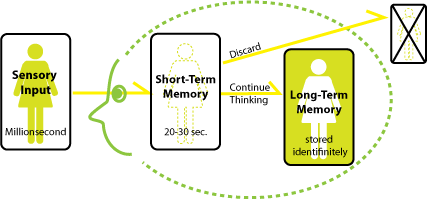
Working Memory: This is one particular type of short-term memory. It is what we are conscious of right now and it can hold thoughts, impressions, sensations for a matter of only a few seconds. It can hold just five to seven items at a time. This is why it was determined years ago that phone numbers be kept to seven digits.

Implicit Memories: The unconscious memories of past experiences that are recalled automatically in carrying out a reflexive action or rehearsing a learned skill. For example, we call upon implicit memories to ride a bicycle or back our car out of the driveway. Thankfully we do not have to consciously remember how do perform these tasks every time as that would make life extremely exhausting. (If I understand correctly, these are like habits-what we now do without thinking.) Eric Kandel explains that an implicit memory “is recalled directly through performance, without any conscious effort or even awareness that we are drawing on memory.”

Explicit Memories (or “complex memories”): This is usually what we mean when we talk about our memories–the recollections of people, events, facts, ideas, feelings, and impressions that we’re able to summon into the working memory of our conscious mind. What we say we remember about the past. Like, right now I am remembering the awesomeness that was the Killswitch Engage concert at Bogarts in Cincinnati June 2013. That is an explicit memory that I just now brought back up into my working memory.

We could say that our working memory is like our scratch pad and our long-term memory (explicit) is like the filing system. Here’s what is so cool: whenever we drag a file out of our long-term memory to the scratch pads of our working memory before us right now (which is called “system consolidation”), it becomes a short-term memory again. It is reconsolidated, and gains a new set of connections–a new context.

“The brain that does the remembering is not the brain that formed the initial memory. In order for the old memory to make sense in the current brain, the memory has to be updated.” *

Biological memory is in a perpetual state of renewal. Have you ever read a book for a second time five or ten years after first reading it? It seems like a different book doesn’t it? Because you are a different person than you were when you first read it. Your brain has updated all the information to your current context.

Computer memory does not renew, it merely stores information as bits of data. Here’s where proponents of outsourcing our memory confuse working memory with long-term memory. 

When a person fails to consolidate a fact, an idea, or an experience in long-term memory, he’s not “freeing up” space in his brain for other functions. In contrast to working memory, with its constrained capacity, long-term memory expands and contracts with almost unlimited elasticity. Thanks to the brain’s ability to grow and prune synaptic terminals and continually adjust the strength of synaptic connections. “Unlike a computer,” writes Nelson Cowan, an expert on memory who teaches at the University of Missouri, “the normal human brain never reaches a point at which experiences can no longer be committed to memory; the brain cannot be full.” Says Torkel Klingberg, “The amount of information that can be stored in long-term memory is virtually boundless.” Evidence suggests, moreover, that as we build up our personal store of memories, our minds become sharper. The very act of remembering, explains clinical psychologist Sheila Crowell in The Neurobiology of Learning, appears to modify the brain in a way that can make it easier to learn ideas and skills in the future.**

We don’t constrain our mental powers when we store new long-term memories. We strengthen them. With each expansion of our memory comes an enlargement of our intelligence. The Web provides a convenient and compelling supplement to personal memory, but when we start using the Web as a substitute for personal memory, bypassing the inner processes of consolidation, we risk emptying our minds of their riches.**

Again we see here the efficacy of the Bible’s encouragement to meditate upon God’s Word, works, and Person. To be single-mindedly focused so as to absorb Him. If we always go to Bible Gateway for Scripture recall instead of consolidating it within our hearts, the Word will remain on the page and lifeless. Meditation brings the Word off the page and into our very being where it can be in that perpetual state of renewal and thus transform us over time.

So the depth of our intelligence, of our very being even, hinges on our ability to transfer information from our working memory into our long-term memory where it can process and associate.

This challenge of transfer can be likened to filling a bathtub with a thimble. You know what, this is enough for today. We’ll talk about filling a bathtub with a thimble tomorrow.

Have a great day!


*Joseph LeDoux

**From The Shallows by Nicholas Carr

In the Name of Jesus,
Soli Deo Gloria

4.17.15–>”Long-Term & Short-Term Memory”

memory

Colossians 1:6

The same Good News that came to you is going out all over the world. It is bearing fruit everywhere by changing lives, just as it changed your lives from the day you first heard and understood the truth about God’s wonderful grace.

There’s quite a process that happens in our brains in transferring a short-term memory into a long-term memory. Short-term memories are rather fragile, and take about an hour to become fixed or “consolidated” in the brain. Studies of boxers who had received concussive punches showed that they lost memory of the couple hours surrounding the fight. Those memories did not have a chance to log into long-term memory status.

Here’s another interesting study: A group was given a list of nonsense words to memorize and then tested on their memory of them the next day. No problem. But another test was conducted having a group memorize a list of words, and then study a second list immediately after learning the first list. The next day they could not recall the first list. A third test was done then having a group study the second list two hours after the first. This group did fine, like the first.

So the conclusion is that consolidation takes an hour or so, is delicate, and can be interrupted by a hit to the head or a simple distraction. Without getting into all the science of it, long-term memories require the synthesis of new proteins. Short-term memories do not.

The more times an experience is repeated, the longer the memory of the experience lasts. Repetition encourages consolidation. OK, here’s a little science: when the physiological effects of repetition on individual neurons and synapses were examined by super smart people, they found something amazing. Not only did the concentration of neurotransmitters in synapses change, altering the strength of the existing connections between neurons, but the neurons grew entirely new synaptic terminals. The formation of long-term memories, in other words, involves not only biochemical changes, but anatomical ones. It’s only been about ten years that we have been able to see that the number of synapses in the brain is not fixed–it changes with learning! Long-term memory persists for as long as the anatomical changes are maintained. Our memories, unlike computers, don’t just store information, they “grow” it.

Here’s what biologist Eric Kandel, who has done extensive memory study, says: “The growth and maintenance of new synaptic terminals makes memory persist.” Our experiences continually shape our behavior and identity. ” The fact that a gene must be switched on to form long-term memory shows clearly that genes are not simply determinants of behavior but are also responsive to environmental stimulation, such as learning.”

Do you see this??? We’re talking epigenetics here, people, another fascinating topic. But what we’re seeing now is physiological evidence that you are not a slave to your genes. You don’t have to become your dad or your mom or anyone else in your family that you do not wish to become! God made us so wonderfully, that we can grow into whoever we wish to become. Even if for the worse, of course. We have that choice.

The nature vs. nurture debate has gotten a lot more interesting. We are leaning that nurture does indeed trump nature. At some point in life we are able to take control of our environment in many ways. I guess it is true on some level that we become the the average of the three to five people we spend the most time with, but most of the time in adulthood we choose those people.

Your brain really will change if you write down three things you’re thankful for everyday and review them often.

Whatever we fill ourselves with over and over, we do become.

Here’s where the lost art of memorizing Scripture comes in. Filling with God’s truth so that we are able to synthesize it as Erasmus talked about. As opposed to reading and forgetting, not filling up with so much information that nothing sticks. (This is what Nicholas Carr argues that the internet is promoting–take in tons of information at an impossible rate to assimilate..that rhymes!)

We become what we fill ourselves with and think about most, what we allow to be our environment.

This is why it can be so difficult to follow Christ while embedded in a Christ-less culture. If we’re always around people trying hard to make tons of  money, or look perfect, well, you get the idea. I see why the monks went to the desert way back in the day.

The only person who says you cannot change is you.

I think Rocky Balboa said it best at the end of the epic Rocky IV:

“I seen a lotta changin’ goin’ on here tonite…And if I can change, then you can change. EVERYBODY CAN CHANGE!!!”

How ahead of his time he was…

In the Name of Jesus,
Soli Deo Gloria

4.16.15–>”More On Memory (not moron memory)

commonplace

Psalm 139:14

Thank you for making me so wonderfully complex! Your workmanship is marvelous-how well I know it.

So Erasmus’ recommendation to keep a notebook of memorable quotes and what not was widely and enthusiastically followed. These notebooks came to be called “commonplace books” or simply “commonplaces.” And by the seventeenth century their use had even spread to the schoolhouse. Commonplaces were seen as necessary tools for the cultivation of an educated mind.

In 1623, Francis Bacon observed that “there can hardly be anything more useful” as “a sound help for the memory” than “a good and learned Digest of Common Places.” He said that a well-maintained commonplace “supplies matter to invention.” This continued through the eighteenth century.

But the popularity of these commonplaces ebbed as the pace of life quickened in the nineteenth century, and by the mid twentieth century, memorization itself was not so cool anymore. Even educators in classrooms were seeing it as a waste of time, thinking it got in the way of imagination. Then, of course, as new forms of media storage kept arriving on the scene, we really lost our motivation for committing anything to memory. We can just search the tape, microfiche, hard drive, etc. The internet has come to be seen as a replacement for rather than a supplement to memory. We see it as freeing us up so we can use our brains for other more important tasks.

But is it freeing us up?

People now routinely make comparisons between artificial memory and biological memory as if they’re indistinguishable.

But are they?

Is memorization an obsolete waste of time now?

In 1892 William James said that “the art of remembering is the art of thinking.” Would he just be laughed at now as old fashioned? I mean if our memory serves only to recall information, then why not outsource it to free us up? Well, because our brain’s memory system, we have discovered, serves to do much more than merely retrieve information.

Tomorrow’s episode: “Short-term and long-term memory.” This really is going somewhere good, if you’ll be patient. Our brains are amazingly crafted by YHWH, and brain science keeps proving Jesus and the Bible to be the truth of truth to be followed for lasting peace.

In the Name of Jesus,
Soli Deo Gloria

4.15.15–>”Memory”

Shallows

Psalm 77:11-12

But then I recall all you have done, O Lord; I remember your wonderful deeds of long ago. They are constantly in my thoughts. I cannot stop thinking about your mighty works.

Socrates predicted that as people became more and more accustomed to writing things down, as well as reading the thoughts of others, that they would become less dependent on their memory. You wouldn’t need to memorize anything anymore. You could just look it up.

True.

But what happened as the written word became more popular back in the day was that people were supplied with a much more diverse supply of the thoughts and stories of others. The culture of deep reading actually encouraged the commitment of printed information to memory. Instead of memorizing only from what was narrowly available and what society determined memorization-worthy, people now were inspired to chart their own course of reading and memorization.

So, in worrying that books would weaken memory, Socrates was, as Italian novelist and scholar Umberto Eco says, expressing “an eternal fear: the fear that a new technological advancement  could abolish or destroy something that we consider precious, fruitful, something that represents for us a value in itself, a deeply spiritual one.” The fear in this case proved to be misplaced. Books actually provide a supplement to memory, as we shall see. They also, as Eco puts it, “challenge and improve memory; they do not narcotize it.” But a technology would later arrive and serve to narcotize…

The Dutch humanist Desiderius Erasmus, in his 1512 textbook De Copia, stressed the connection between memory and reading. He encouraged his students to write town in a notebook anything interesting or important to them as they were reading. Writing these excerpts out in longhand, and rehearsing them regularly, would help ensure that they remain fixed in the mind. These passages were like “kinds of flowers” plucked from the pages of books to be preserved in the pages of memory.

Erasmus had memorized huge amounts of classic literature as a schoolboy. So much so that it would probably blow our minds today and of course we  probably do not see the point it now. But he was not memorizing for memorization’s sake or as a rote exercise in retaining facts. To him, memorizing was far more than just a means of storage. It was the first step in the process of synthesis, a process that led to a deeper and more personal understanding of one’s reading. He believed, as the classical historian Erika Rummel explains, that a person should “digest or internalize what he learns and reflect rather than slavishly reproduce the desirable qualities of the model author.” This is far from a mechanical, mindless process. It engages the mind fully. It required, Rummel writes, “creativeness and judgement.”

The Roman Seneca eloquently spoke of the role memory plays in our reading and thinking: “We should imitate bees, and we should keep in separate compartments whatever we have collected from our diverse reading, for things conserved separately keep better. Then diligently applying all the resources of our native talent, we should mingle all the various nectars we have tasted, and then turn them into a single sweet substance, in such a way that, even if it is apparent where it originated, it appears quite different from what it was in its original state.”

Our memory, as we shall see from neuroscience, is as much a crucible as a container. It is much more than merely a bunch of things remembered. It is something ever newly made.

I can witness to the efficacy of writing down what moves me from various places, and assimilating them. One example of the fruit of this is what we’ve called the “Guiding Principles” and on the Ripple Effect website here. By writing things down and reviewing them often, ideas become your own. None of us are coming up with anything truly original, so we may as well steal what we find and synthesize it to make it our own unique life-enhancing wonderfulness.

More tomorrow…


This info comes from Nicholas Carr’s excellent book from the picture above.
Fascinating, enlightening book.

Forward this email to a friend

In the Name of Jesus,
Soli Deo Gloria

4.14.15–>”Memorization”

Memory-Retention-Forgetting-Curve-800

Psalm 119:11

I have hidden your word in my heart, that I might not sin against you.

We don’t memorize much anymore. Largely because we don’t have to. Machines memorize for us now. And, in general, we only do what we have to do. Are we missing out on anything? Is it hurting us in any way?When was the last time you memorized something, be it Scripture or petty, or song?

What was that like for you?

A few years back, I was inspired by someone who said they committed to memory a few passages of Scripture as opposed to isolated verses.

So I’ve memorized, with his inspiration, the following key passages:

Psalm 16
John 15:1-11
Colossians 3:1-17
Romans 8:1-8

as well as Richard Foster’s The Prayer of Authority that you can read here.

So what has this done for me?

Made me into awesome memory guy?

Or is there more going on?

Well, we shall explore what is going on with memory in more detail in the days ahead.

It may be deeper than you think…

In the Name of Jesus,
Soli Deo Gloria