Some of your hurts you have cured,
And the sharpest you still have survived,
But what torments of grief you endured
From the evil which never arrived.
-Ralph Waldo Emerson
All posts by Rob Pallikan
4.14.15–>”Memorization”

Psalm 119:11
I have hidden your word in my heart, that I might not sin against you.
We don’t memorize much anymore. Largely because we don’t have to. Machines memorize for us now. And, in general, we only do what we have to do. Are we missing out on anything? Is it hurting us in any way?When was the last time you memorized something, be it Scripture or petty, or song?
What was that like for you?
A few years back, I was inspired by someone who said they committed to memory a few passages of Scripture as opposed to isolated verses.
So I’ve memorized, with his inspiration, the following key passages:
Psalm 16
John 15:1-11
Colossians 3:1-17
Romans 8:1-8
as well as Richard Foster’s The Prayer of Authority that you can read here.
So what has this done for me?
Made me into awesome memory guy?
Or is there more going on?
Well, we shall explore what is going on with memory in more detail in the days ahead.
It may be deeper than you think…
In the Name of Jesus,
Soli Deo Gloria
4.13.15–>”Triads”

Matthew 18:20
“For where two or three gather together as my followers, I am there among them.” -Jesus Christ
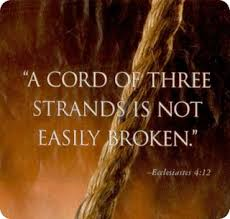
Ecclesiastes 4:12
A cord of three strands is not easily broken.
Another awesome form of community, in addition to partnerships of two, is the triad. This is a very fancy word for “three people.”
We talked yesterday about my spiritual partnership with Dave and how powerful it has been in my life. God has also gifted me with a wonderful and deep partnership with my good anamchara, Todd. Even as a pastor, he realized the great benefit and necessity of this focused form of community. Or maybe I should say especially as a pastor. So if you think me crazy, and I don’t blame you as I often doubt my own sanity, there’s at least one pastoral endorsement here.
Todd hooked me up with Rex, and we formed a triad of partnership sometime around a year ago. Since they both have the last name Fisher, I like to call us “Roberto Y Los Pescadores”, which Rex tells me was an academy award nominated foreign film from 1987. (There’s a little controversy on this title for us since my name appears first.)
There is great power in triads. It is laser focused on our seeking of God and supporting one another. It’s small so that no one gets lost or can hide in the corner. “Hey Rex, what are you doing back there by yourself?” doesn’t happen due to the extreme awkwardness that would naturally ensue due to the nature and intensity of a group of three. There’s also a beauty if, like in this group, you have three pretty different personalities. (If you’re into the enneagram, we are a three, a four, and seven) This is helpful for the other perspectives they bring, always out of care. You don’t wanna meet with two other people just like you if you really want to pursue growth. You’d probably just end up telling each other how awesome you are and that there’s no need to change a thing. Hey, that sounds nice, actually!
By the way, the picture at the top is of me, Rex, and Todd before those two cut their hair. I believe it captures well our friendship and what it means.
So I’ve been wondering lately if our Sunday gatherings and small groups should have as a focus, the facilitating and funneling of people into these triad types of partnerships. The small group thing was really “it” for a while in churches, and they’re good, but I hear all the time of people getting lost or not being challenged there. Some of this is simply due to the size of the group. We do need both the big gathering and the house church groups I feel, or else we’d all just be running around wondering where to find and meet with Christ followers.
These small focused partnerships, though, are where people are experiencing some really awesome growth because of the safety to share and confess, and the intense care of the soul that this type of group is more conducive to.
The blessing I’ve received and still receive from these Fisher men is off the charts. Knowing that they love me deeply and that I can call them at any time about any thing is a great comfort to me. They only want the best for me, plus Todd buys me books and Rex installs new water heaters and things in my house. Just sayin’.
In the Name of Jesus,
Soli Deo Gloria
4.12.15–>”Spiritual Partnership”

Hebrews 3:13
But encourage one another every day, as long as it is called “Today,” so that none of you may become hardened by the deceitfulness of sin.
In The Ripple Effect, we’ve always talked about the three legs of the stool necessary for growing into Christ–Prayer, Scripture, and Partnership. This month, we’ve looked at prayer in the form of the examen, Scripture ingestion by way of lectio divina, and we now turn to look at community as spiritual partnership. Some of you know the story of the beginnings of my spiritual partnership with my soul friend, David Lowe.
It was a stormy nite…..not really, just a mild afternoon. But that’s not important. What is important is the great need for and efficacy of community, and specifically in this form–spiritual partnership. Anamchara, if you’re fancy.
Something God showed us in the fall of 2011 was ridiculously simple, and yet profoundly impactful. God is good at that sort of thing. We had already been partnering for some months when Dave called me up one day and said, “Hey, can you do me a favor? Can you call me every day at 4:00?” “Sure, whatsup?” He went on to tell me that this is about the time he starts to lose it, you know that after-lunch-not-quite-the-end-of-the-day time period, where you can easily forget what’s important. What we call the devil’s hours, 2-5 pm for most people.
So I began to call everyday at 4:00. Little did we know the tremendous breakthrough this would give to our spiritual walk and growth. It was literally that daily encouragement written of in Hebrews 3:13.
Ridiculously simple. Profoundly impactful.
He said that even on the days he could not pick up the phone due to work, he was reminded by just seeing my call of why we are here, what is important, and that someone else out there is rooting for him and praying for him.
And he was greatly encouraged.
We grew exponentially from this daily encouragement. Who knew?
It is amazing what encouragement can do for us. We cannot oversell it. The “daily check-in” was God’s gift to us. We began implementing it in our Ripple Effect groups where other people could reap the benefits of this constant ministering.
There’s a few things going on in this type of partnering:
- Rhythms–We operate optimally under rhythms, I believe. A daily rhythm such as this fits in with how God made us and the universe, sunset and sunrise, ocean tides, waking and sleeping, etc. They are just “facts of determined existence.”* We need rhythms and order so badly these days in this frenetic, overwhelming culture we find ourselves swimming (drowning?) in.
- Trust–Someone who has earned your trust is amazing for spiritual growth. Yes, I do believe this can be very true of your spouse, and hopefully is the case. At the same time, many of us know and have experienced the unique value of having, in addition, someone outside your marriage, of the same gender, to encourage you and challenge you. I believe we all need this.
- Challenge/Mirror–We need to be challenged. We just do. We need someone else to be our mirror to tell us when we’re being a jackhole and don’t realize it. As we say, you need a mirror to know there’s basil in your teeth**. Without this aspect of challenge, our growth we’ll be quite slow. Our partnership will be feel-good fluff. Dave has lovingly called me out more than thrice, and for that I’m grateful. As he told me early on in our partnership, “Rob, I will never judge you, because I’ve done it all. But I will tell you when you’re screwing up, because I care about you.” I shall never forget those words, and appreciate the fact that he has lived up to that meaningful statement.
- Safety–Like trust, someone we can share all with and not be judged. Remember what shame needs to grow: secrecy, silence, and judgement. So you could say that partnership is like “Shame-Away”, as seen on TV!
The enemy wants to isolate us in order to put us in a weakened state. We must make one of our mantras “Withdrawal is not an option!” Sometimes it just comes down to, We all suck. But together we suck less.
Hopefully it is at least somewhat helpful to look at these practical tools for the Christian life as we remain focused on the point of it all, to become one with Christ and then precipitously become a part of the healing of the nations.
It is our hope that anyone reading this will be drawn closer to Jesus Christ and experience the peace that only He can give.
John 14:27
And as always, “If it doesn’t throw you into the arms of Jesus, then throw it out!”***
*footnote Luke Mertes
**footnote Emily Gosser
***footnote Kristin Fuller
In the Name of Jesus,
Soli Deo Gloria
4.11.15–>”Lectio Divina” (part 3)

Psalm 1:1-2
Oh, the joys of those who do not follow the advice of the wicked, or stand around with sinners, or join in with mockers. But they delight in the law of the Lord, meditating on it day and night.
Lectio Divina consists of four parts:
- Lectio (reading)
- Meditatio (meditation)
- Oratio (prayer)
- Contemplatio (contemplation)
Or, if you’re not into the whole Latin thing, and prefer alliteration, some put it as
- Read
- Reflect
- Respond
- Rest
*Me, I think I’m forever ruined by alliteration as I heard enough of it in Baptist preaching growing up to last me about four lifetimes. Which is also why I was adamantly opposed to naming our children with first letters anywhere near each other in the alphabet. “G” and “Z”, 19 letters apart, I can live with that. But I digress.*
So when sitting down to hear from God via Lectio Divina, you choose a rather small passage of Scripture to focus on, usually no more than ten verses. The idea is that you will really get to know the passage. You’re not going for quantity here, so you may start with just two or three verses. You will end up reading the passage around four or five times and focusing in on possibly just one word the Spirit reveals to you.
Here’s a guide to practicing it that I like and have adopted from Dallas Willard’s Hearing God:
Reading-lectio
Read the passage slowly.
S l o o o o w l y.
Now that the words are familiar, read the passage again.
This time, listen with the ear of your heart for a word or phrase, a detail of the story that shimmers or stands out to you. It may even be a person in the passage that you resonate with.
Do not choose this yourself. Let the Spirit bring it to you. Even if you don’t like it, try to welcome it with meekness and see what happens (James 1:21).
Reflect-meditatio
Read the passage again slowly.
As you do so and for a few moments afterward, reflect on the word or phrase that stood out to you.
Sit with it and chew on it over and over. (I’ve heard that the word for meditation was linked to the chewing of cud or a dog chewing on and savoring a bone. This is what you do with the word or phrase. It’s amazing how much will come to you through this process.)
Why do you think these words resonated with you?
Then ask God, “How does this connect with my life today?”
“What do I need to know, or be or do?”
Give yourself a few moments to do this.
Respond (Pray)-oratio
Read the passage one last time, preparing yourself for what you want to say to God, about what you think the Spirit might have said to you or what came to you.
Pray however you are led to pray.
You might thank God for something or ask God for something.
Rest-contemplatio
Do as you are led.
You may wish to wait on God-to simply be with God.
You may wish to ponder, How did God seem in this passage?
Is there anything about Christ that makes you marvel at Him or makes you want to worship Him?
Contemplation differs from meditation in that you really aren’t thinking during contemplation, just sitting in the presence of God, soaking in it.
For me personally, reading Scripture in this manner has been extremely life-giving to me. I’ve heard from God clearly on so many occasions and been given His peace that I’ve felt in the most real sense. Until diving into this about four years ago, I did not know what I was missing.
Again, let us be clear, we are not talking magical incantations here. We’re not trying to focus on a method but rather further and more deeply focus on God alone by opening ourselves up to hear from Him more clearly. This is a beautiful way that I and thousands of others have found to turn up the volume of Jesus and consequently quiet the noise of the world always rushing in.
“Go out and stand before me on the mountain,” the LORD told him. And as Elijah stood there, the Lord passed by, and a mighty windstorm hit the mountain. It was such a terrible blast that the rocks were torn loose, but the LORD was not in the wind. After the wind there was an earthquake, but the LORD was not in the earthquake. And after the earthquake there was a fire, but the LORD was not in the fire. And after the fire there was the sound of a gentle whisper. When Elijah heard it, he wrapped his face in his cloak and went out and stood at the entrance of the cave.And a voice said, “What are you doing here, Elijah?” I Kings 19:11-13
Just as the hand, held before the eye, can hide the tallest mountain, so the routine of everyday life can keep us from seeing the vast radiance and secret wonders that fill the world.
-Chasidic saying, eighteenth century
“It’s amazing what I can hear when I shut my big yapper.”
-Me, just now, 2015
*rabbit trail
Forward this email to a friend
In the Name of Jesus,
Soli Deo Gloria
4.10.15–>”Lectio Divina” (part 2)


Psalm 119:148
My eyes are awake before each watch of the night, that I may meditate on your promise.
We humans are meant to live in an ongoing conversation with our God, speaking, and being spoken to. I believe one of the main reasons for reading Scripture is to allow ourselves to be spoken to by God.Some say that it is dangerous to have someone read the Bible without teaching them how to read it.The Bible is best engaged in a spirit of silence, of meditation, and reflection, and most important of all, in the context of prayer in order to realize its power to transform us.Silence is key.
I love Thomas Keating’s words: “Silence is God’s first language; everything else is a poor translation.”
That which is infinite cannot be put into a finite container. Therefore, the Bible, if it really is God’s word handed down to us, needs a “new” way of reading. It beckons for a different way of ingesting that we may not be use to. This new way of reading does not change the Bible, but how we approach it. This is the secret of Lectio Divina’s power.
Reading a spiritual text in the “normal” way of reading can have the unintended consequence of pushing God further into hiding. How? We fill ourselves with more head knowledge, crowding out His actual presence. Instead, we read as an act of slow, deliberate prayer. In an unhurried receptive manner. Listening.
In contemplative prayer, you listen in receptive silence, and hold yourself open for the purpose of fostering the experience of God’s presence within you. You listen for and to the “Helper” that Jesus told His disciples about:
“This other helper is the spirit of truth. The world can’t receive him, because it doesn’t see him or know him. But you know him, because he lives with you, and will be in you.” John 14:17
Tomorrow, we’ll start to look at the actual practice of Lectio Divina.
I do believe God speaks directly to us via the Holy Spirit, but as the humorous picture above suggests, the Spirit’s communication is many times and usually quite clearly through Scripture. Without the Scriptural foundation, especially the four Gospel accounts, then we are quite likely pursuing someone or something other than YHWH.
As David Benner well says, “the God we must come to know is uniquely revealed in His word. Even though the word became flesh, we must start our knowing of the Word in Scripture, not simply in our inner experience.”
And the monks of Saint Meinrad put it this way, “We…follow the Benedictine way of seeking God with the Gospel as our guide.”
In the Name of Jesus,
Soli Deo Gloria
4.9.15–>”Lectio Divina” (part 1)

Psalm 145:5
On the glorious splendor of your majesty, and on your wondrous works, I will meditate.
“Let the world be silent in your presence, Lord, so that I may hear what the Lord God may say in my heart. Your words are so softly spoken that no one can hear them except in a deep silence. But to hear them lifts him who sits alone and in silence completely above his natural powers, because he who humbles himself will be lifted up. He who sits alone and listens will be raised above himself.”
-Guigo II
-Guigo II
Lectio Divina is a Latin term that means “Divine Reading” or “Sacred Reading.”
It is an ancient monastic practice that employs a particular method of reading. It is a unique, listening approach to reading that enables you to open up the time you spend with the written word so that your reading becomes a doorway to meditation, prayer, and contemplation.
Historically, it to go back to Origen in the third century, Benedict and his order in the sixth, and Guigo II’s formal instructions in the twelfth.
It is a powerful tool for opening up to the presence of God in your life, in your interaction with sacred Scripture. It opens you up to allow God to lead you where He chooses. You do not choose. You do not seek to control but rather to yield. In a sense, you could say that the text reads you.
Lectio Divina is not mere intellectual exploration, but about actually becoming intimate with God. You’re not studying God. You’re getting to know God.
Before the printing press and modern ideas of scholarship, research, and academic pursuit of knowledge, those who wrestled with the words of Scripture did so to acquire a spiritual, rather than intellectual understanding of the text. It was not an exercise in “figuring out” Christianity, but rather a practice for encountering God through the medium of the written word. The goal of Lectio Divina is simply to create space where God may encounter you via the sacred word.
The ancient spiritual practice of Lectio Divina suggests that, in terms of fostering intimacy with God there are approaches far more valuable than mere study and analysis. That may stimulate the brain, but not transform the heart. Knowing about God more than knowing God.
To be continued…
Forward this email to a friend
In the Name of Jesus,
Soli Deo Gloria
4.8.15–>”The Prayer Process”

So in keeping with our look at some foundational spiritual practices, and coming off the examen prayer, I wanted to also share something I found a couple years ago that I found helpful and meaningful: The Prayer Process.As has happened to me a few times now, whenever I make fun of a book title, it is that very book that becomes one of my favorites upon actually reading it. So a couple years ago, my spiritual partner Dave and I went to retreat at Saint Meinrad monastery, and each guest room had this book by Matthew Kelly, The Four Signs of a Dynamic Catholic. Growing up non-catholic, I was like, “What is this? Sounds so cheesy.”
So I pick it up, subconsciously in order to probably mock it, and wouldn’t you know it, it’s really good and pulled me right in. So basically the book is based off of studying the catholic church and specifically those who are the most involved ministering and serving. You know the ole 80/20 rule? 20% of the people do 80% of the work? Well, in this study, they found it was actually 7% doing most of the load. The new 93/7 rule.
So they studied this 7%. What did they have in common? What’s going on there? Well, they found many things, but just four things that they ALL had in common, which were:
- Prayer – They are committed to daily prayer
- Study – They are continuous learners
- Generosity – They are very generous with their time and money
- Evangelization – They invite others to grow spiritually by sharing the love of God with them
So here is what he gives as a possible starting point to prayer, a contemporary version of the examen. You might like it.
THE PRAYER PROCESS BY MATTHEW KELLY From THE FOUR SIGNS OF A DYNAMIC CATHOLIC (2012) His Web Site: DynamicCatholic.com
Be Bold. Be Catholic.
In The Prayer Process we take time – a minute, two minutes or maybe ten minutes – to spend time with the Lord every day. Pick a specific time when you will pray; ex. Morning Prayer or Night Prayer. It is an intentional way that we grow in our faith. The seven steps of The Prayer Process are as follows:
- Gratitude: Begin by thanking God in a personal dialogue for whatever you are most grateful for today.
- Awareness: Revisit the times of the past twenty-four hours when you were and were not the-best-version-of-yourself. Talk to God about these situations and what you learned from them.
- Significant Moments: Identify something you experienced today and explore what God might be trying to say to you through that event (or person).
- Peace: Ask God to forgive you for any wrong you have committed (against yourself, another person, or Him) and to fill you with a deep and abiding peace.
- Freedom: Speak with God about how he is inviting you to change your life, so that you can experience the freedom to be the-best-version-of-yourself.
- Others: Lift up to God anyone you feel called to pray for today, asking God to bless and guide them.
- Finish by praying the Our Father.

Forward this email to a friend
In the Name of Jesus,
Soli Deo Gloria
4.7.15–>”The Examen Prayer” (part 4 of 4)

James 1:22-25
But be people who do the word, not merely people who hear it and deceive themselves. Someone who hears the word but doesn’t do it, you see, is like a man who looks at his natural face in the mirror. He notices himself, but then he goes away and quickly forgets what he looked like. But the person who looks into the perfect law of freedom, and goes on with it, not being a hearer who forgets but a doer who does the deed–such a person is blessed in their doing.
The fifth and final step of the examen is Renewal.
You look forward to the following day and, with God, plan concretely how to live it in accord with God’s loving desire for your life.
We have looked back in order to look ahead. We allow the past to illuminate the future. This is actually learning from our life and tangibly moving forward accordingly for spiritual growth. Again, we don’t do this for the exercise’s sake, but to move toward God in the growth He desires for our lives.
We look forward to tomorrow and what keystone habit we may need to institute, what God is asking us to be aware of, or who to encourage. We look at who we will be with and pray for what is needed there, be it patience, wisdom, self-control.
We are constantly learning from our experiences…if we take the time to reflect on them and proceed out of what we learn from that reflection. Someone said it is not our experiences that change us, but rather our reflection upon them. We go through many experiences every day, every week, all our life. We don’t necessarily grow from them automatically. We can just go through stuff and stay stuck where we are unless we are strategic in looking and learning and changing whatever courses necessary for spiritual progression.
The examen, remember, is a tool. A tool to bring us closer into oneness with God and to clear space for the Holy Spirit to fill. It also serves to s l o w u s d o w n. And in general, it is always good to slow down and smell the roses. Unless you’re being chased by a puma.
I believe this prayer to be a basic foundational practice that is of utmost value to anyone who really takes it on.
Always, only, for my King
4.6.15–>”The Examen Prayer” (part 3)
Romans 4:7
Oh, what joy for those whose disobedience is forgiven, whose sins are put out of sight.
Step four: Forgiveness.Out of step three’s review of our day, in which we search for our consolations and desolations, we will inevitably be drawn to seek God’s forgiveness for our wrongs we have uncovered.
Timothy Gallagher makes a great point on this step, so let me quote from the first section on his chapter on forgiveness:”This step in which we ask for and receive God’s forgiveness touches deep relational spaces in our hearts. We must approach it with great sensitivity, for much in the practice of examen depends upon how we understand and what our hearts feel in regard to this: asking God’s forgiveness.
“Jean Vanier writes: ‘Forgiveness and celebration are at the heart of community.’ The two pillars that sustain relationships are the joy of togetherness and the readiness, when human limitation emerges, to ask forgiveness. Vanier continues:
‘We can only truly accept others as they are, and forgive them, when we discover that we are truly accepted by God as we are and forgiven by him. It is a deep experience, knowing that we are loved and held by God in all our brokeness and littleness.’
“In its fourth step, the examen is the privileged daily space of this ‘deep experience’ of ‘knowing that we are loved and held by God in all our brokeness and littleness.’ To live the fourth step daily in all its richness strengthens our communion with God and empowers us to be agents of healing forgiveness in our communities, in our families, and in society as a whole.”
So forgiveness has a lot to do with our image of God, how we relate to one another, and of course avoiding cancer–be it emotional or even physical.
If our image of God is based on Jesus, Scripture, and nature, I believe we will then realize God is loving, merciful, and forgiving. That He has already dealt with our sin through Jesus’ sacrifice, so there is nothing to fear in approaching YHWH. The curtain separating us from God has been torn. It is only up to us to approach then. Confessing our failings brings healing via the touch of God. We are human. We are limited. We fail. Admit it. Release it. As God does. It actually feels pretty good to do so.
“The God of Christian revelation is a God who rejoices in the encounter of forgiveness, whose loving forgiveness respects human dignity and heals human hurt. Joy is nowhere so repeatedly mentioned in the Gospels as in Luke 15, the chapter of the parables of forgiveness: the lost sheep, the lost coin, and the prodigal son. The profound link in the Scriptures between God’s forgiveness and joy indicates that the more truly we experience step four of the examen, the more this step will become a time of joy.”
And remember what Tozer said: “Whatever comes into your heart and mind when you think about God is the most important thing about you.”
Relating to others. Make allowance for each other’s faults, and forgive anyone who offends you. Remember the Lord forgave you, so you must forgive others. (Col.3:13) There’s a few places in the Bible mentioning that we will be forgiven the same measure we forgive. If we believe this, and our image of God is good, we will pretty darn quick to forgive. (We could start an organization named “PDQ Forgiveness”!) There is no healthy relationship without forgiveness. A while back we described forgiveness as:
Actively relieving others of payment for their wrongs against you. Our punishment of others, which is their payment, often comes in the form of our silence, but may also be our disgusted stare, slander, defamation, or simply our inner resentment.
Forgiveness refuses to punish with silence.
Forgiveness does not punish with a disgusted stare.
Forgiveness does not punish with slander.
Forgiveness does not punish with defamation.
Forgiveness does not nurture inner resentment.
Forgiveness is not easy.
There is no healthy relationship without forgiveness. Which leads us to avoiding cancer. So my mom, trying desperately to get me to eat green beans-which I hated, would tell me at dinner, “Rob, eat at least three green beans or you might get cancer.” Now I may be misquoting her slightly, but it was something like that, something mildly traumatizing. But we could definitely utter in truth a similar phrase related to forgiveness. “Relieve people of payment for their wrongs against you or else get cancer.” Maybe not physically (though I think that’s a possibility because of one story of someone I know), but at least emotionally or spiritually. Unforgiveness will tear you up inside. Don’t try it. It will eat away at you until not much is left of who you once were.
So forgiveness is huge. Receiving, as well as giving. It is healing. Even more than green beans.
Tomorrow, the fifth and final step: Renewal.
Always, only, for my King