Category Archives: Daily Meditations

The Source of Living Water

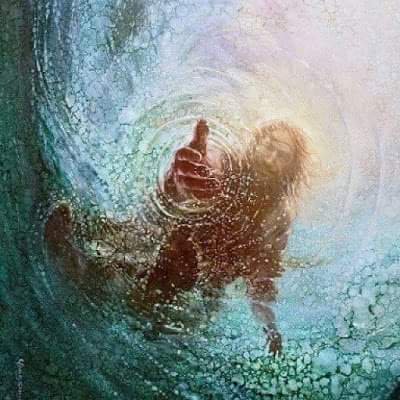
reach-thru-water

John 7:37-39

On the last day of the festival, the great day, while Jesus was standing there, he cried out, “Let anyone who is thirsty come to me, and let the one who believes in me drink. As the Scripture has said, ‘Out of the believer’s heart shall flow rivers of living water.'”

Now he said this about the Spirit, which believers in him were to receive; for as yet the Spirit had not been given, because Jesus was not yet glorified.

The person who believes in Jesus as Lord of all will drink of the Spirit which derives from Jesus, and this shall be the source of their energy and life.

That is really all we want to say today. That Jesus Christ, the risen person who is alive today, and reigns with the Father and the Holy Spirit is the source of life from which we who believe drink and are filled. Going anywhere else but Him alone for life will leave you thirsty to varying degrees.

Jesus is not some dead guy of the past. He was not merely a great teacher or good moral example to follow.

He is.

He is the source for all life and your soul will not find rest until it rests in Him.

He said, “Come to ME.” Come directly to Me. If you are not feasting upon the risen Christ for your energy, then you are living beneath what you were lovingly created for!

How do we drink from the Well that is Jesus?

Perhaps we can talk about that tomorrow.

Just know today and meditate upon the fact that Jesus Himself is your source of life. You need go to no other person, no book, no church to receive life. You need must go to the Life Giver Himself who is always open-armed waiting for you to come to Him. After that, AFTER, He then may direct you to people or books or a church. Maybe. I don’t know. You’ll have to ask Him.

Check out Isaiah 65:1-2 sometime today.

Starbucks Fumes

living-water-international-photo

Yesterday a friend replied to The Daily Ripple on the difficulty of being with the suffering, and it inspired further thoughts on the subject.

I wanted to share her opening line I found so profound and thought-provoking:

I would say that suffering is draining, so if you don’t have energy from the true Life Giver to be able to pour out Spirit love, then you’re just trying to operate on your Starbucks fumes.

Wow. That says so much, doesn’t it? “Starbucks fumes.” This is so metaphorically rich in just two words. You can see the deep meaning begging for extrapolation, can’t you?

Suffering does indeed drain the other person. This isn’t bad or wrong, it just is. Therefore, unless you’re regularly drinking from the Well of Living Water and eating the Bread of Life, you won’t be able to be much comfort to those who are going through the rough times of life around you.

But many of us are living our lives of no margin burning for energy our Starbucks fumes as opposed to the jet fuel of God’s grace-His Spirit and energy which directs our steps and replenishes us supernaturally.

You can’t do a 6,000 mile road trip on one tank of gas and no sleep, trust me, we did a 6K road trip this summer. Yet that’s what we try to do. You must stop. You must refuel. You must rest. The more we try to do, the less we have available for others. The less margin. No margin means no availability for the person on the side of life’s road who’s been beaten down and in desperate need of a helping hand, which often is a listening ear AKA a fully engaged spirit.

My friend also mentioned a man from her church so inspiring because he seemed to always be at the right place at the right time with an encouraging word, prayer, or meal. He doesn’t keep a meticulous Google calendar, she says, he just walks in the Spirit. He’s not even particularly smart or gifted. He simply prays, reads the Bible, and believes!

Who is Jesus?

jesus-face-side

Who is Jesus?

Who do you say He is?

This is the most important question of your life.

Not what does church say?

Not what do your parents say?

But what do you say?

Who do you say Jesus is?

Perhaps takes some time today to sincerely ponder this and plumb its depths. Many of us, even church-goers, have yet to give this question the attention it deserves.

Self-Loathing

SELF-loathing

It’s been said that to maintain proper perspective, you must keep your own sin ever before you, reminding you of your deep need for God and His continual forgiveness; and to keep others’ sins out of  your mind, covering them with the blankey of your love (I Peter 4:8).

One person suggests to “let your awareness of your sin and sins be real and intense, but never let it degenerate into self-loathing–an ugly deviation from attention to God.”

An ugly deviation from attention to God.

That is the best definition of self-loathing I have ever heard!

Again:

SELF-LOATHING–> An ugly deviation from attention to God.

Francis of Assisi said (in the context of his order of friars) to “take care not to be disturbed or angered at the sin or the evil of another, because the devil wishes to destroy many through the fault of one.”

The devil wishes to destroy many through the fault of one.

Wow.

How true.

One pastor falls, and many lose their faith.

My wifey showed me a post the other day that basically said: if you have lost your faith in God because of a bad experience with some church, then your faith was never in God to begin with, it was in people.

Foundations

church fathers

One of my favorite C.S. Lewis quotes is, “People need to be reminded more often than they need to be instructed.” I agree wholeheartedly. Which is why I’ve been reading a lot of the earliest Christian writings this year. It is good to be reminded of what the first Christians thought and believed and held on to for dear life.

One of those early church fathers was Athanasius of Alexandria (296-373) who wrote the amazing work “On The Incarnation.” [There were early church mothers too, quite prominent in the early church, but unfortunately the culture being what it was, we have very little of what they said or wrote.] In the English translation I that read, it had an introduction by C. S. Lewis, and in it he wrote that he encouraged his students, and all Christians, to read an ancient work for each modern one. Why? Well for one, the ancient classics have been tried and proven for centuries. Modern works are still “on trial.” The classics are classics because they transcend time and culture. Also, they take us back to our foundations, and those early church leaders were dedicated to preserving in written form the basics of Christianity. It is always good to be reminded of these truths we hold as core to our belief, indeed, to our lives.

Boniface Ramsey is an author who has studied the early church fathers and translated many of  their works himself. He lists what they affirm as broad theological propositions  that have remained central to Christian orthodoxy across almost all denominational lines. They are:

  • Belief in a triune God
  • The fully human and fully divine natures of Christ
  • The redemptive efficacy of Christ’s death on the cross
  • The absolute authority and infallibility of Scripture
  • The fallen condition of humanity
  • The significance of baptism and Holy Communion
  • The vital importance of prayer and a disciplined spiritual life

Ramsey says, “Belief in these things, which the fathers unanimously proclaimed, even if they proclaimed them in different ways, continues to be the distinguishing marks of  Christianity to this day.”

Amen.

And I would say, just to be crystal clear, that it is implicit from this list that they believed in the bodily resurrection of Jesus (redemptive efficacy), which is why it is so prominent in all of the early creeds. And they and the biblical writers believed that Jesus was in fact God (YHWH) in human form. On this they are quite clear.

So there you have it, a quick look at those basics of our faith, that are always good to review.  I am amazed at how many people claiming to be Christians have a problem with multiple things listed here. Don’t get me wrong, this is no checklist mentality, but rather the stuff of life given to us by Jesus Himself. If you have issue with any of these basic foundational beliefs of our faith, I encourage you to look into them more deeply.

I hope this has been helpful!

Kavvanah

Kavvanah, also spelled Kawwanah (Hebrew: “intention,” or “devotion”), plural Kavvanot, Kavvanoth, Kawwanot, or Kawwanoth, in Judaism, the attitude or frame of mind that is appropriate when one performs religious duties, especially prayer.

KAVVANAH (Heb. כַּוָּנָה; lit. “directed intention”), the phrase used in rabbinic literature to denote a state of mental concentration and devotion at prayer and during the performance of mitzvot. Although the demand for kavvanah as an obligatory component of religious prayer and action is not explicitly mentioned in the Pentateuch, it is clearly referred to by the prophets. Isaiah, for instance, condemns those who “with their mouth and with their lips do honor Me, but have removed their heart far from Me” (Isa. 29:13).

Kavvanah in Prayer

The Talmud attaches considerable importance to kavvanah in prayer. The Mishnah quotes R. Simeon’s dictum: “Do not regard your prayer as a fixed mechanical device, but as an appeal for mercy and grace before the All-Present” (Avot 2:13). It is, furthermore, related that the early ḥasidim used to wait an hour before and after prayer to achieve a state of kavvanah and emerge from it (Ber. 5:1). However, from the discussion in the Mishnah and the Gemara (Ber. 32b), it is clear that the rabbis, keenly aware of the “problem” of prayer were by no means unanimous in their interpretation of what proper kavvanah should be. Later medieval authors distinguished between the preparation for kavvanah which precedes prayer and the achievement ofkavvanah during prayer itself (e.g., Kuzari, 3:5 and 17), while repeatedly stressing the importance of both. Maimonides ruled as a matter of halakhah (which was not, however, agreed with by later codifiers) that “since prayer without kavvanah is no prayer at all, if one has prayed without kavvanah he has to pray again with kavvanah. Should one feel preoccupied or overburdened, or should one have just returned from a voyage, one must delay one’s prayer until one can once again pray with kavvanah… True kavvanah implies freedom from all strange thoughts, and complete awareness of the fact that one stands before the Divine Presence” (Yad, Tefillah, 4:15, 16). The Shulḥan Arukh states “better a little supplication with kavvanah, than a lot without it” (OH 1:4).

Many talmudic decisions relating to kavvanah were modified in the course of time. Thus, although the Mishnah (Ber. 2:5) states that a bridegroom is not required to read the *Shema on his wedding night (because he would not be able to achieve a proper degree of concentration), it was later ruled that “since nowadays we do not pray with proper attention in any case” he must do so (Sh. Ar., OH 60:3). Similarly, “even if one did not recite the Amidah with kavvanah, it is not necessary to repeat it,” since it is assumed that the kavvanah of the repetition would be no better (ibid., 101:1, and see Isserles, ad loc.).

In the Kabbalah kavvanot (the plural of kavvanah) denotes the special thoughts one should have at the recitation of key words in prayer. Very often these thoughts are divorced from the contextual meaning of the words and are of a mystical, esoteric nature. Some kabbalists were thus known as mekhavvenim (i.e., those who have kavvanot) and guides to kavvanot were written (cf. Emmanuel Ḥai Ricchi’s Mafte’aḥ ha-Kavvanot, Amsterdam, 1740).

Kavvanah in Mitzvot

This is defined as the intention of the person performing the action to do so with the explicit intention of fulfilling the religious injunction which commands the action. One example of a lack of kavvanah quoted in the Mishnah (Ber. 2:1) is the case of one who reads the Shema during the morning (or evening), for the purpose of study and not fulfillment of the mitzvah; another is the case of one who hears the shofar on Rosh Ha-Shanah accidentally and thus does not have kavvanah for the mitzvah (RH 3:7). All authorities agree that due kavvanah to perform such mitzvot is desirable. There is, however, a difference of opinion as to whether mitzvot performed without kavvanah are valid, or whether they must be repeated (cf. Ber. 13a; RH 28a; Sh. Ar., OH60:4).

If You Want to Get Warm You Must stand Near the Fire

If you want to get warm you must stand near the fire: if you want to be wet you must get into the water. If you want joy, power, peace, eternal life, you must get close to, or even into, the thing that has them. They are not a sort of prize which God could, if He chose, just hand out to anyone. They are a great fountain of energy and beauty spurting up at the very center of reality. If you are close to it, the spray will wet you: if you are not, you will remain dry. Once a man is united to God , how could he not live forever? Once a man is separated from God, what can he do but wither and die?

~ from Mere Christianity, by C.S. Lewis.

Spiritually Starving in the Midst of Plenty

pike

A wall-eyed pike is put into an aquarium. He is fed for some days with little minnows. Then, in the middle of the experiment, a glass partition is placed down the middle of the aquarium so that the pike is now confined to one side.

Then the researchers drop the minnows on the other side. Immediately, the pike goes for the minnows, but he hits himself against the glass. He circles and hits it again. He tries a third time, but he is now hitting the glass a little less hard. After a few more times, he’s just sort of nosing up against the glass. He has a feeling he’s not going to get those minnows. Pretty soon, he just swims around in circles and ignores the minnows on the other side.

At that point, those doing the experiment take out the glass. The minnows come right up against the gills of the pike and he doesn’t even try to eat them.

The experiment ends when the wall-eyes pike starves to death. He’s convinced he’s not going to get those minnows, so there’s no point in wasting his time or hurting his nose again. That is the best image of cultural blindness I have heard. I wanted to weep when I first heard it, but I realized that the experiment is about human beings, not about fish. That’s much of the human story, people spiritually starving in the midst of plenty. They don’t know how to eat.

-from Job and the Mystery of Suffering by Richard Rohr

This is an amazingly accurate metaphor for us, I believe. Starving in the midst of plenty.

The incredible, overwhelming, ginormous truth that is ever hiding right out in the open is this–we already have everything we need at this, and at every, moment.

We can always turn to God.

Only the eyes of faith are able to see this.

There is always a great feast sitting on the table.

Always.

Whether we see it, eat it, acknowledge it, or not.

I hear Jesus saying to us, “You can turn to me at any time.”

The Bread of Life, which leaves you hungry for nothing more, is always on the table ready to be taken and ingested.

God is always available to the diligent seeker, who approaches in utter humility, with a contrite heart, empty of self. We are free and able to connect with Christ at any moment of any day, if we but desire Him. I mean, truly desire HIM beyond all else.

The energy of God is ever flowing all around, in, and through us. We may tap into it whenever we so choose. We may stop whatever we are doing and thinking at any point, and turn our attention fully to Christ and rest in Him. When your attention is turned wholly to one thing, it is, by default, turned away from all others. Turning to the one thing needed, turns you away from all that matters not.

Is there any greater gift than this?

Is there anything simpler?

Is there anything more essential?

Is there anything more hidden?

“You can turn to me at any time.”

We need nothing else than to turn the gaze of our soul upon God in focused attention, and all will be made clear, for perspective shall miraculously become “unwarped” from its off-center state. Such intense focus on Christ, which blinds us to all else, is peace indeed–and worth fighting for.

Your healing presence absorbed, dear Jesus, is everything. May all other activity and thought take its rightful, very distant, second place to this!

There is plenty of food on the table. Minnows are constantly swimming right up to your gills. You may partake whenever you choose. What’s stopping you?